Pike Engineering Distribution Playbook

Turn the Playbook into a clear operating roadmap.

This site helps leaders understand the model, assess their team’s stage, and know what structure, metrics, and trigger points are needed to scale.

Your journey as a Pike Leader

01

Start with PURPOSE (the WHY)

If the WHY isn't clear, nothing else scales. Anchor decisions to purpose and value.

02

Learn the Pike operating system (the HOW)

Business models, zone structures, leaderwork, and discipline. This is how we deliver value that isn’t easily replicated

03

Build the system (BEST-IN-CLASS)

Use the playbook to evaluate whether your current structure and focus match the growth plan.

5-Year Destination

Best-in-class service, great leaders, $500M revenue, and 30% gross margin.

Pause & reflect

Use this playbook as a leadership compass

  • Am I doing CORE work or just reacting to what’s urgent?
  • Is my structure designed to deliver value?
  • If volume doubled tomorrow, would my model and leadership system hold?

Purpose Alignment Dashboard

The Playbook starts with WHY before structure.

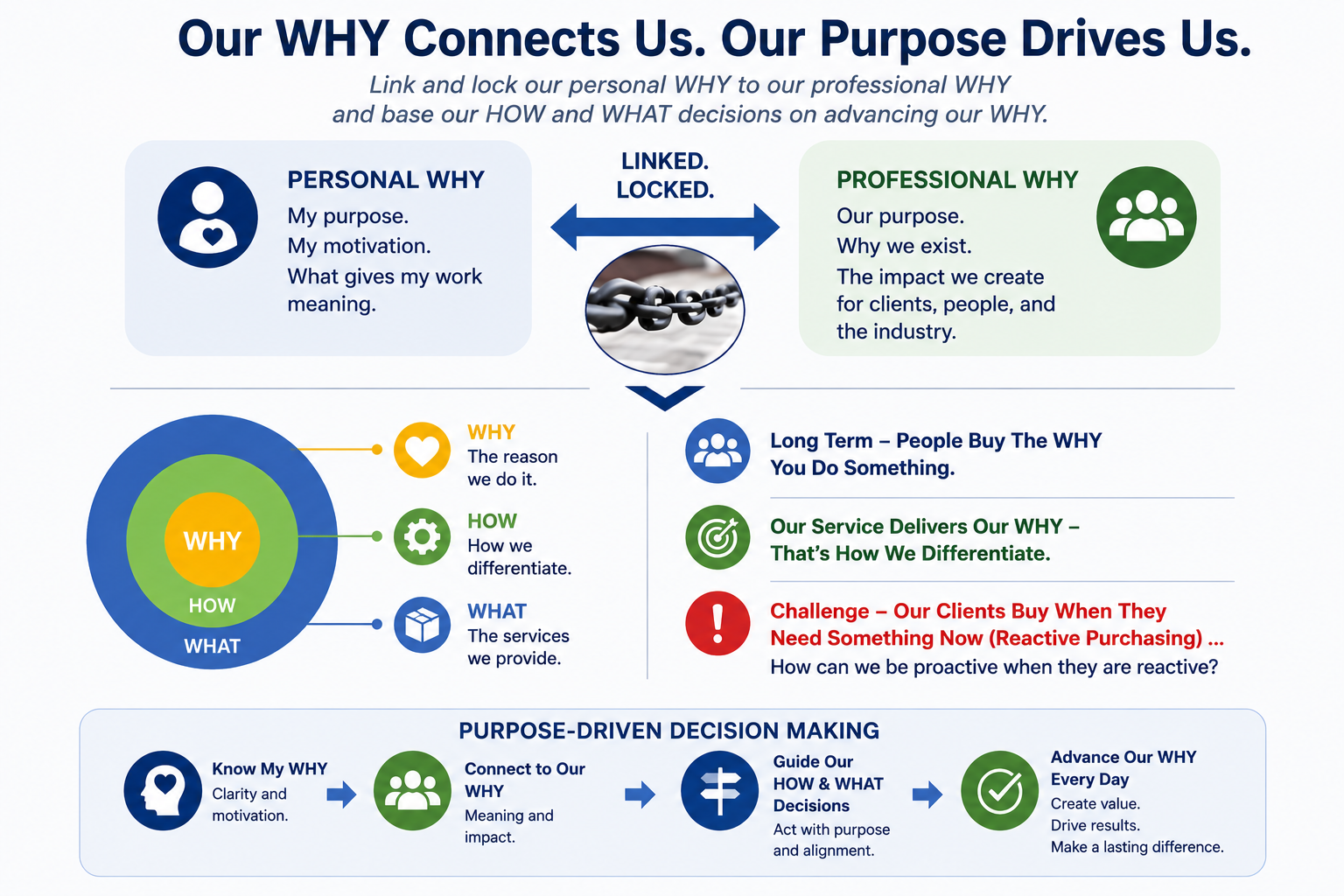
Pike’s philosophy is that operating models, org charts, KPIs, and leadership systems only work long-term when we understand the WHY behind the work. We judge decisions by one test: does this advance our WHY, or distract from it?

Pike’s WHY

We exist to enable our clients to achieve their critical infrastructure goals with Best-In-Class Value and Integrity.

WHY

The reason we do the work and the impact we want to create.

HOW

The operating behaviors and leadership systems that differentiate Pike.

WHAT

The services, work products, and operational outcomes delivered to clients.

Purpose driven leadership and WHY framework
Purpose & Leadership

Understand the WHY framework, leaderwork, and leadership philosophy.

Learn the models

Compare Traditional, POD, and Hybrid models.

Org Structures

Understand Base Zone, Super Zone, and role clarity.

Find my stage

Assess your team and see the next operating model.

Improve KPIs

Focus on workload, production, backlog, cost, and quality.

Executive Framework

The Playbook is organized into three parts.

Leaders should read the Playbook as a progression: first understand the purpose and leadership expectations, then build the operating model, then keep improving the system as the business scales.

Part 1

Foundation: Purpose, Leadership, Best-in-Class Service

Establishes why Pike Engineering Distribution exists, what leaders are expected to focus on, and what best-in-class service means.

Includes

  • Our Purpose
  • Senior Leadership
  • Best-in-Class Experience

Leadership focus

Purpose, leadership expectations, customer experience, repeatable discipline, differentiation, and CORE work.
Part 2

Operating Model: Business Models, Org Structures, Performance

Defines the models, structures, roles, PM discipline, and metrics needed to deliver best-in-class service consistently.

Includes

  • Distribution Business Models
  • Organizational Structures
  • Performance System
  • Stage Navigator

Leadership focus

Traditional, POD, Hybrid, Base Zone, Super Zone, PM pillars, KPIs, reporting, trigger points, and role clarity.

Part 3

Scale: Leadership, Technology, Administrative Excellence

Captures the wisdom, tools, technology, training, and support systems needed to keep improving as the model grows.

Includes

  • Leadership
  • Technology Strategy
  • Administrative Excellence

Leadership focus

Purpose-driven leadership, technology adoption, process improvement, application ownership, operations support, and continuous improvement.

Purpose System

Purpose comes first.

It is the filter for our business model, organization, metrics, leadership, and client decisions.

Purpose Driven

Helping our clients achieve their critical infrastructure goals with best-in-class value and integrity.

The Playbook starts with WHY. Every business model, org structure, KPI, and leadership decision should advance the purpose.

Best-in-Class Is the Standard

All services should be delivered at best-in-class levels.

The goal is not just to complete work. The goal is to create a customer experience that earns trust, expands opportunity, and differentiates Pike.

Repeatable Discipline

Scalable growth requires repeatable operating discipline.

Growth without discipline creates bottlenecks, inconsistent quality, unclear reporting, and leadership overload.

CORE Work Builds the Future

CORE work is long-term, sustainable distribution work aligned to Pike’s core skill sets.

Reactive bid work may grow revenue, but CORE work builds identity, long-term client value, and sustainable leadership focus.

Leaderwork Over Taskwork

Senior leaders must spend time on the work only they can do.

The Playbook depends on leaders building future capability, developing key leaders, aligning to clients, and seeing client needs before they do.

Operating Model

From structure to scale.

Model Selection Dashboard

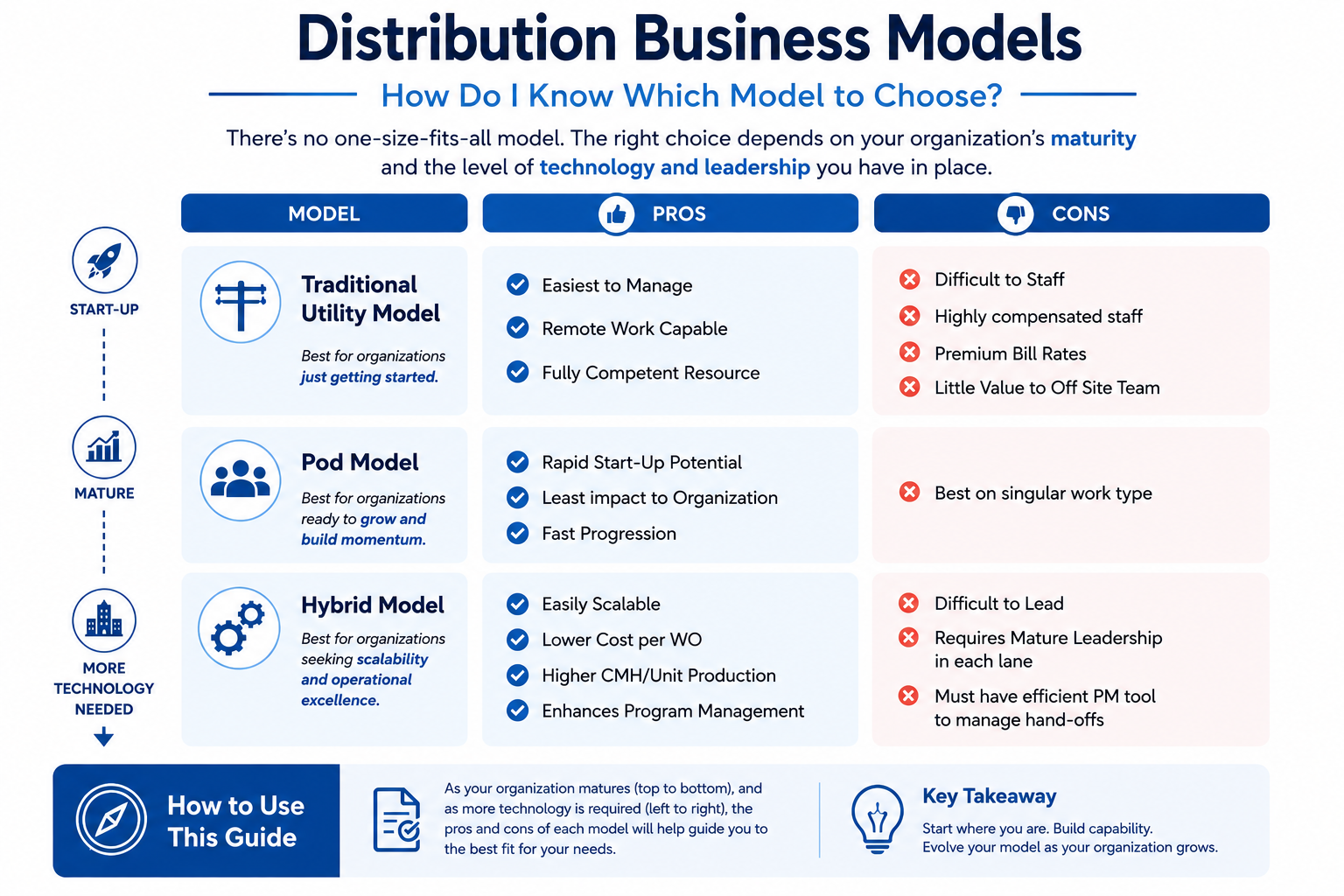
Choose the model based on maturity, technology, and leadership capacity.

The Playbook makes one thing clear: there is no one-size-fits-all delivery model. The right choice depends on where the team is today, what the client needs, and whether the organization has the maturity to manage handoffs, PM discipline, and technology-enabled scale.

Traditional Utility Model

Easier to manage and fast to start, but harder to staff and less scalable.

POD Model

Strong for singular, repeatable work types where the team can build momentum around a focused lane.

Hybrid Model

Most scalable and cost-effective, but requires mature leadership, efficient PM tools, and disciplined handoffs.

Distribution business models comparison
Base Zone Organizational Structure

Org Evolution Dashboard

Base Zone creates the first scalable leadership structure.

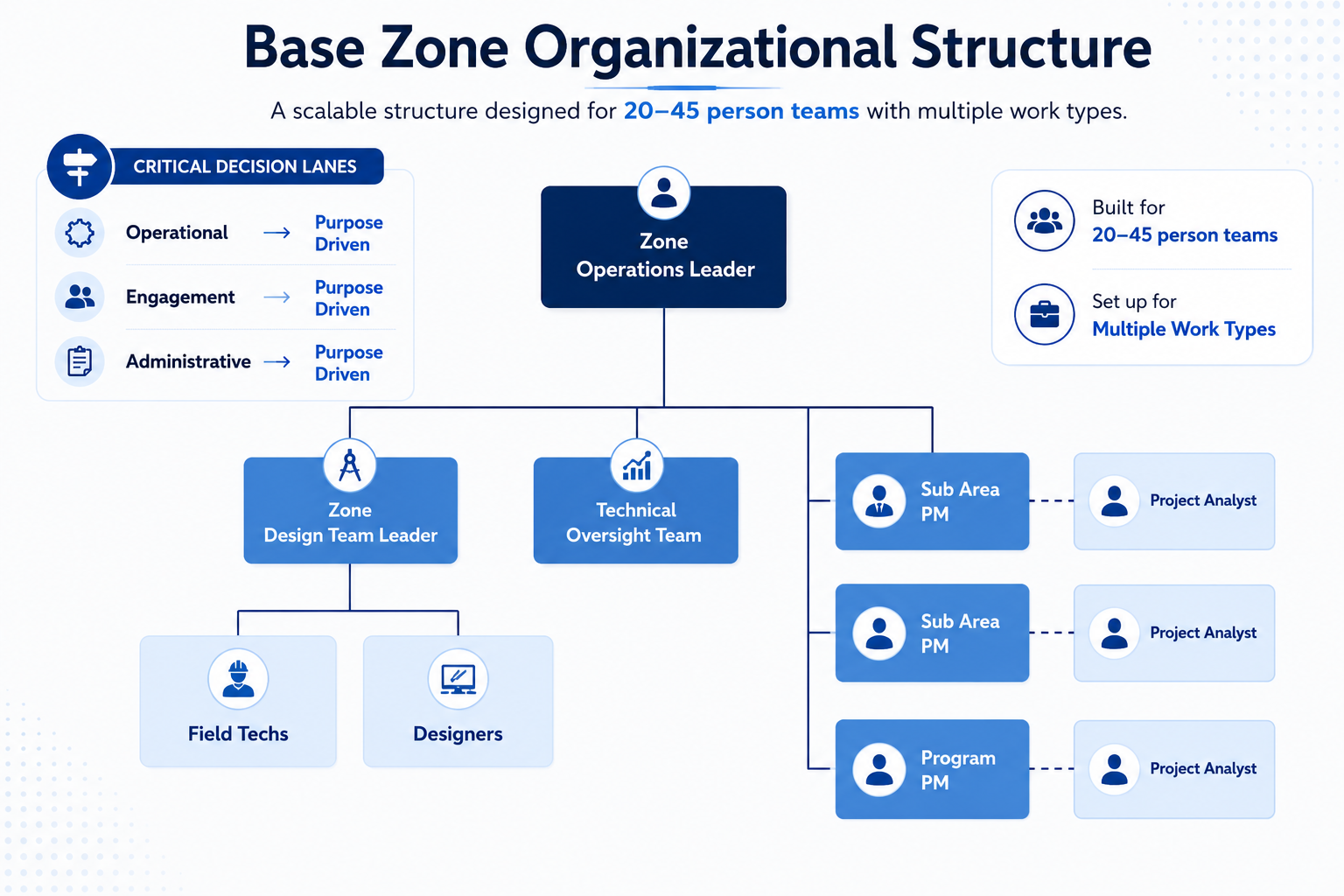
The Base Zone model is built for 20–45 person teams with multiple work types. It creates clear separation between execution, PM discipline, and technical oversight while keeping the team purpose-driven across operational, engagement, and administrative decision lanes.

Execution lane

Zone Design Team Leader owns production through field techs and designers.

PM lane

Sub Area PMs and Program PMs own scope, schedule, cost, tracking, and customer communication.

Technical lane

Technical Oversight protects deliverable quality, standards, compliance, and process improvement.

View org structures →

Scale & Leadership Capacity Dashboard

Super Zone protects scale when Base Zone leadership capacity is stretched.

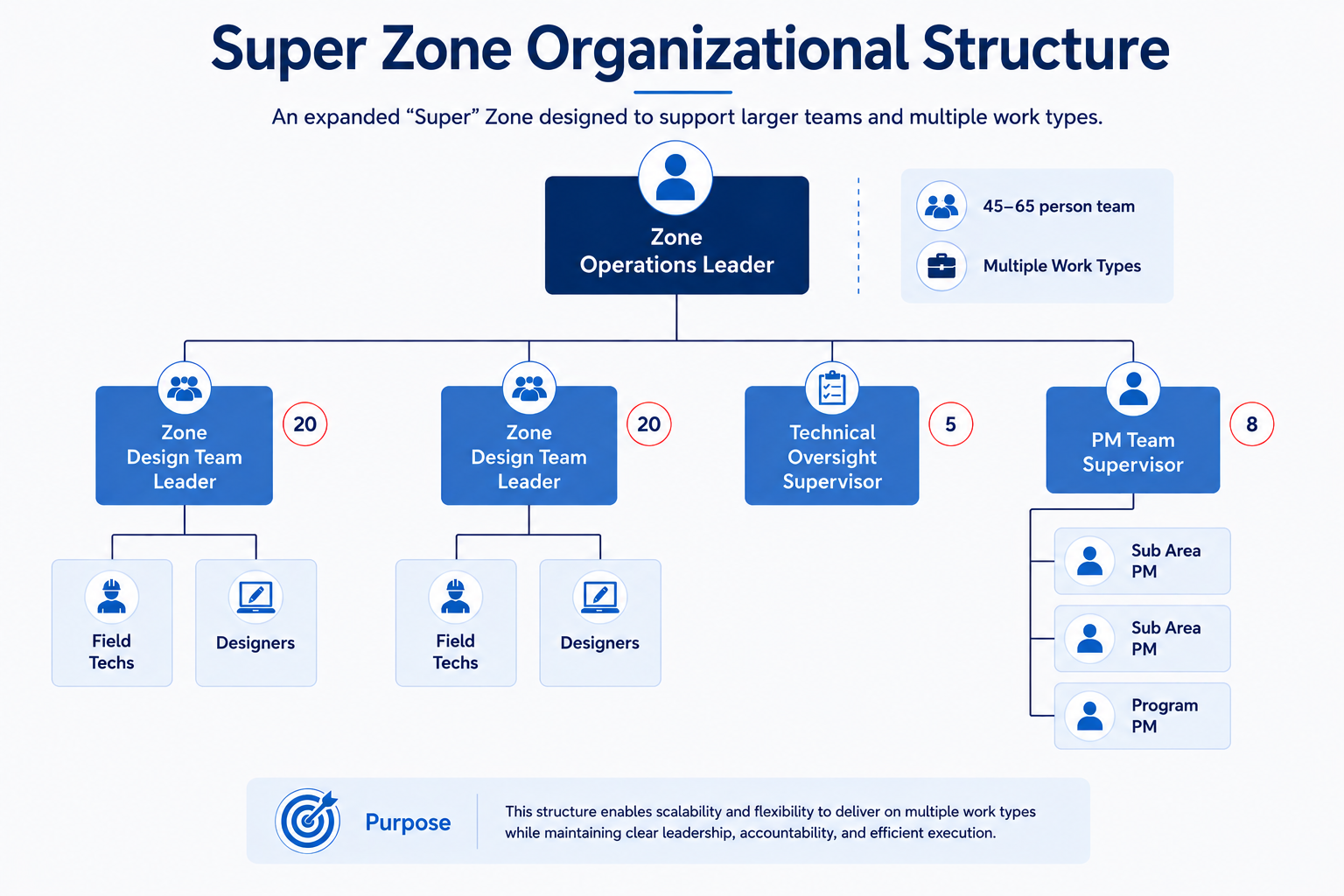
As work volume, team size, and work types increase, the organization needs more leadership leverage. The Super Zone creates stronger separation between design execution, PM leadership, and technical oversight while preserving accountability.

Larger team capacity

Designed for larger teams, expanded execution groups, and multiple work types operating at once.

Leadership leverage

Adds supervisory layers so one leader is not the bottleneck for production, PM decisions, quality, and client needs.

Cleaner accountability

Keeps execution, PM team leadership, and technical oversight clear even as the organization grows.

View Super Zone →
Super Zone Organizational Structure

Best-in-Class Experience Dashboard

Best-in-class is our operating behavior.

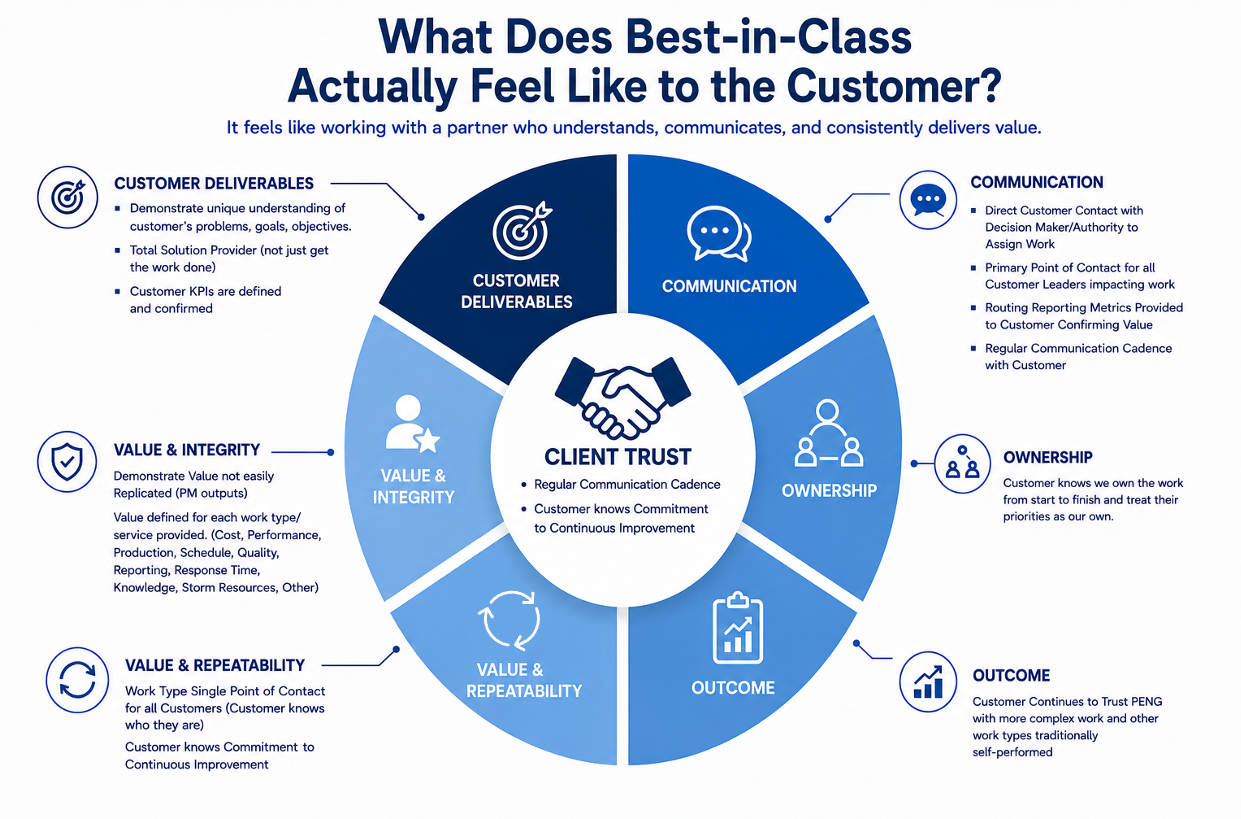
The Playbook defines best-in-class service as a customer experience built on communication, ownership, repeatability, value, integrity, and measurable outcomes. The goal is to become a trusted operating partner.

Communication

Consistent reporting cadence, direct customer engagement, and visibility into performance.

Ownership

Treat customer priorities like our own and lead problems instead of reacting to them.

Repeatability

Create systems that scale quality, production, and client confidence.

Value & Integrity

Deliver measurable value through production, quality, responsiveness, and operational trust.

Executive takeaway

The customer should feel like they are working with a partner who understands their goals, communicates clearly, and consistently delivers value.

Best in class customer experience

Executive Performance Dashboard

Every level should know the workload, production, and backlog story.

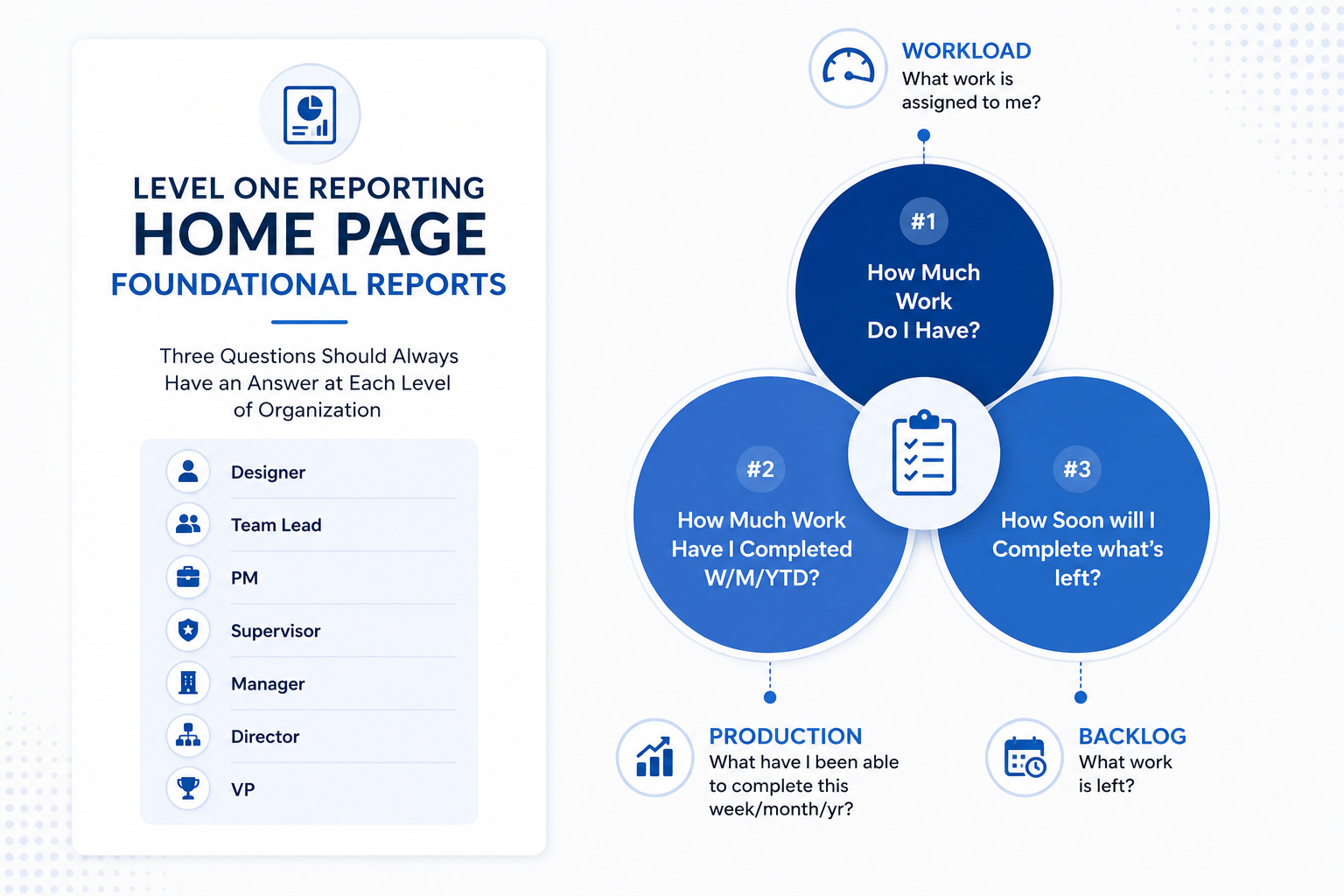
The Playbook’s reporting discipline is simple but powerful: every level of the organization should be able to answer how much work exists, how much has been completed, and how soon the remaining work will finish.

Workload

How much work do I have?

What work is assigned to me or my team?

Production

How much work have I completed?

What has been completed this week, month, and year-to-date?

Backlog

How soon will I complete what is left?

What work remains and when will it be done?

View performance system →
PM tracking and reporting foundational reports

Business Models

Choose the right model.

Traditional Utility Model

A staff augmentation or local utility-style model built around experienced resources and direct customer proximity.

POD Model

A dedicated work team built around a singular work type, high volume, and strong competency.

Hybrid / Off-Premise Model

A blended resource model using the appropriate skillset for each task, with PM ownership over the full lifecycle.

Performance System

Every level should answer three questions.

Workload

How much work do I have?

What work is assigned to me or my team?

Production

How much work have I completed?

What has been completed this week, month, and year-to-date?

Backlog

How soon will I complete what is left?

What work remains and when will it be done?

Engineering Hours / Point

Measures engineering effort required per completed point.

$ / Point

Measures cost efficiency by unit of completed work.

$ / Mile

Measures cost efficiency for mileage-based work.

Blended Bill Rate

Shows the effective rate across mixed resources in the model.

Points / Week

Measures weekly design production throughput.

CMH / Week

Measures construction man-hour production or downstream construction throughput.

Continuous Improvement

Scale requires wisdom, technology, training, and operational support.

As the model grows, leaders must keep refining what works, adopting technology carefully, improving processes, and building support systems that reduce friction for the operating teams.

Leadership

Purpose-driven leadership, positive impact, risk taking, and continuous improvement.

Technology Strategy

Tools that reduce manual work, improve reporting consistency, and automate data flow.

Administrative Excellence

Operations support that keeps onboarding, payroll, equipment, data, and project setup moving.